WHAT COULD HAPPEN?
The True Story of David Hahn
Boy Scout David Hahn, 16, decided to build a breeder reactor in his mother’s suburban backyard potting shed in Michigan. It was 1994 and Hahn was seeking his Atomic Energy Merit Badge. Hahn’s case is a great example of why exemption limits should be tightened, not loosened. But it also indicts a government and the industries it regulates for using radioactive materials in everyday consumer products. A teenager should be free to be curious without risking radioactive contamination of him/herself, family, friends, and neighbors.

It was 1994 and David Hahn thought he was earning the Boy Scout Atomic Energy merit badge. Writing letters, often under false pretenses, David had gotten the information that he thought he needed to build a breeder reactor (using everyday and accessible consumer products) by reaching out to the Nuclear Regulatory Commission (NRC), The American Nuclear Society and The Department of Energy. These entities were extremely accommodating to David’s curiosity.
Using their collective advice, he had collected the radioactive elements required to build a breeder reactor: americium from smoke detectors; thorium from camping lantern mantles (from which he was going to make uranium); radium from old clocks (the element responsible for killing the several young mostly female workers in the early 1900s), and tritium from gunsights. The actions he took to collect the radioactive elements he needed were time-consuming and painstaking. David was undeterred.
Some sources say he never did succeed in building a working reactor, but others think his reactor may have reached criticality. Most sources agree he did succeed in building a crude neutron source, the fabrication of which rendered his mother’s property a Superfund site. The radioactivity from his experiment traveled into the rest of his neighborhood in levels measurable with his Geiger counter. There was some indication that David knew the health risks of his actions, but he was spurred on by the utopian fantasy version of a 1960s book: the Golden Book of Chemistry.
While the neutron source/reactor was running and growing in radioactivity, David learned the fate of the Radium Dial Painters, mostly young women who had suffered and died from the horrible impacts of the radium they used to paint dial faces. He was terrified for his neighbors and himself, and decided to stop his experiment. He packed everything in a toolbox in the back of his Pontiac, and sealed it with duct tape. He was driving around deciding what to do with the radioactive material when he was stopped by police, who thought he was stealing tires. When they searched his trunk, they upgraded their concern to nuclear bomb making.
Eventually, after David had initially misled them about the location of his laboratory, the Environmental Protection Agency (EPA), NRC and Federal Bureau of Investigation were notified that the shed at David’s mother’s house was the actual laboratory; and likely a contaminated site. The people in moon suits appeared, collecting, cataloguing, and eventually disposing of, the radioactive material in the shed; and the highly contaminated shed itself.
An EPA official said that David had some of the highest concentrated material ever in private hands.
The laboratory was dismantled; but unfortunately David and his parents, who were afraid of losing their house when regulators moved in, had earlier disposed of some of the most radioactive material, (including the radium) in the household trash that ended up in the landfill.
Tragically, David never lost his obsession with nuclear material or technology. On August 1, 2007, he was charged with stealing a number of smoke detectors from the halls of his apartment building. His intention was to obtain the americium they contained. Police in Clinton Township said it was a possible effort to experiment with radioactive materials. Again. David was sentenced to 90 days in prison for this crime, which was delayed for six months to accommodate medical treatment.
David Hahn died at the age of 39. His death was ruled accidental.
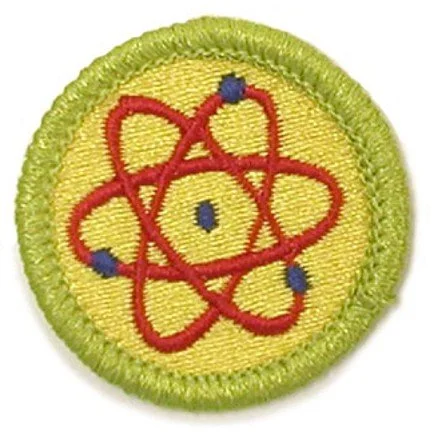
Atomic Energy Boy Scout merit badge approved in 1963. It was replaced with the Nuclear Science merit badge in 2005 that states as its purpose: “…to find out if there is one fundamental rule that explains how matter and forces interact.” The badge requirements however, mostly focus on nuclear energy and industrial and medical radiation applications.